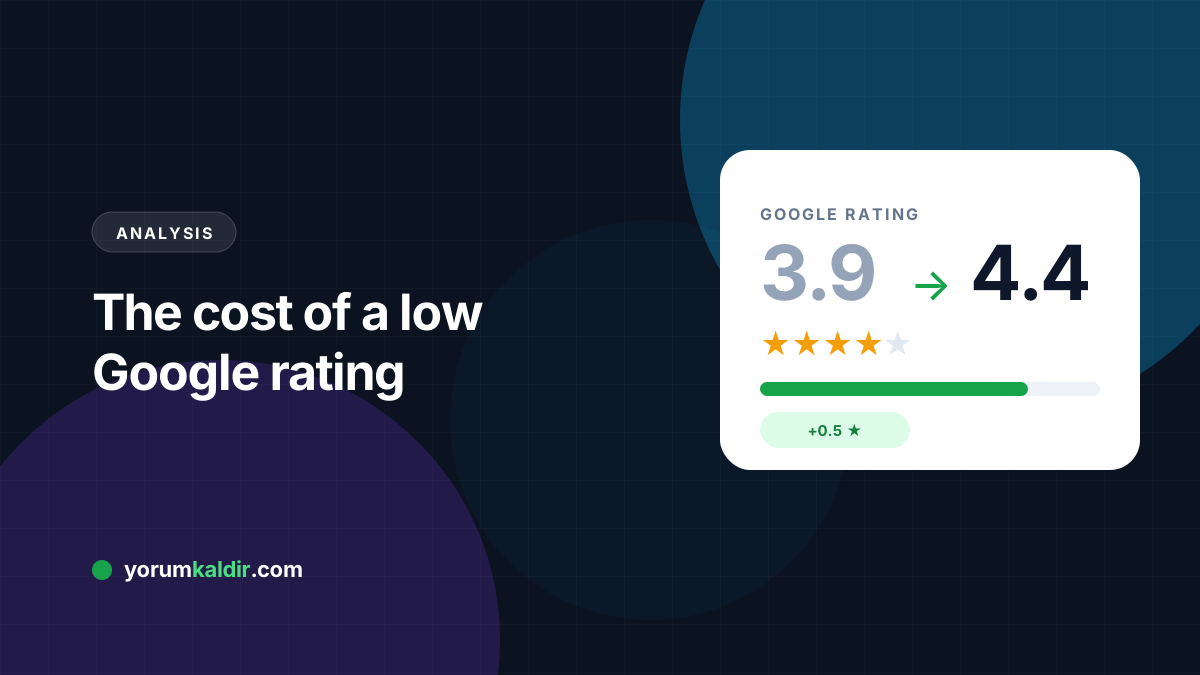
Most people searching on Google Maps never see a business with a Google rating below 4.0. They tap the “Rated 4.0+” filter, scan the top three results and call one of them. If your profile sits at 3.8 or 3.9, you are not losing a few customers at the margin; you are invisible for a large share of searches. This article puts numbers on what a low star rating costs, explains how the rating is calculated, and shows the two levers that improve your Google rating fastest: removing policy-violating reviews and collecting new ones.
How Google calculates your star rating
The number next to your business name is a simple average of all published ratings, rounded to one decimal. Google does not weight recent reviews more heavily in the displayed figure, although users do when reading. That has two consequences. First, every review counts the same whether it was written yesterday or four years ago. Second, removing a review changes both the sum and the count, which is why removal moves the rating more than adding a new review does.
A quick example
Nova Bistro has 180 reviews and a rating of 3.9 (sum of stars: 702). To reach 4.0 by adding 5-star reviews, it needs 18 new reviews: (702 + 5 × 18) ÷ (180 + 18) = 792 ÷ 198 = 4.0. To reach 4.0 by removing unfair 1-star reviews, it needs to remove just 6 of them (696 ÷ 174 = 4.0). Six removals equal eighteen new reviews. Most businesses need both, but the order matters: remove first, then collect.
What a low Google rating costs: the numbers
| Rating band | Visibility in Maps | Typical conversion impact |
|---|---|---|
| 4.5 and above | Shown in all searches, often in the top three | Baseline; highest click-through on calls and directions |
| 4.0–4.4 | Shown in all searches, passes the 4.0+ filter | Slightly lower click-through than 4.5+, still strong |
| 3.5–3.9 | Hidden when the 4.0+ filter is active | Calls and direction requests drop sharply; users compare you unfavourably |
| Below 3.5 | Hidden by the filter and rarely ranked in the local pack | Most users do not consider the business at all |
What the research says
- Consumer surveys consistently show that a large majority of people will not consider a business rated below 4 stars, and that the star rating is the first thing they look at.
- Academic studies of restaurant data have linked a one-star increase in rating to revenue gains in the range of 5–9%.
- Most readers only weigh reviews from the last few months; older negative reviews matter less to humans but still count fully in the average.
- Owner responses increase the share of users who say they would still visit despite a negative review.
What it costs in practice: three fictional cases
Marina Lounge Café (3.9, 1,372 reviews): weekly direction requests in Google Business Profile insights averaged 310. After 38 policy-violating reviews were removed and the rating reached 4.2, the same metric rose to 406 within six weeks, a 31% increase, with no change in advertising.
Atlas Rent a Car (3.7, 540 reviews): the branch was excluded from the 4.0+ filter during the summer peak. Removal of 22 fake and off-topic reviews lifted it to 4.0 in 19 days. Phone calls from the Maps listing roughly doubled in the following month.
Nordlicht Dental (4.1, 210 reviews): already above the threshold, but three abusive reviews naming a hygienist were costing staff morale. Removal took the clinic to 4.3; the measurable effect was smaller, but the clinic’s new-patient form showed “Google” as the source for 48% of new patients versus 39% before.
Lever 1: remove unfair and policy-violating reviews
Removing reviews is the fastest lever because it changes the denominator. It only works for reviews that violate Google policy: fake reviews from people who were never customers, conflict-of-interest reviews from competitors or ex-employees, off-topic rants, harassment, personal data, spam. Roughly one in three 1–3 star reviews with text falls into one of these categories on an average profile; on profiles that have been attacked, the share is far higher.
How the process works
- Scan the profile and list every 1–3 star review with text or photos.
- Classify each review by the most promising policy category.
- Report through the Google Business Profile review management tool, attaching evidence.
- Wait for the 3–21 day decision, appeal once where justified.
- Verify removals and watch the rating recalculate.
The yorumkaldir.com scan shows this as a single figure: your rating potential, the projected rating if every flagged review were removed. For Marina Lounge Café the potential was 4.3 against a current 3.9; it ended at 4.2 because a handful of flagged reviews were kept by Google.
No prepayment and no risk: you pay only per review that is actually removed, after the work is done. Reviews that stay online cost nothing, and reviews from the last 25 days are covered by a 100% guarantee.
Lever 2: collect new positive reviews, the right way
Once unfair reviews are gone, volume takes over. The goal is a steady stream of genuine reviews, not a burst. Google’s systems flag unusual spikes, and incentivised reviews violate policy.
Tactics that work
- QR code at the point of satisfaction: the table, the reception desk, the handover of the car keys. Link directly to the “write a review” URL.
- Timed message: an SMS or email 2–24 hours after the service, when the experience is still fresh.
- Staff script: one sentence, after a thank-you from the customer: “If you have a minute, a Google review helps us a lot.”
- Reply to every review, positive and negative. Profiles that reply get more reviews.
Tactics that get you suspended
- Discounts or gifts in exchange for a review.
- Asking only happy customers while diverting unhappy ones to a private form (review gating).
- Buying reviews from any source, however “organic” they claim to be.
- Reviews from staff, family or the business account.
A realistic 8-week plan from 3.9 to 4.3
| Week | Action | Expected effect |
|---|---|---|
| 1 | Free scan, order removal of flagged reviews, reply to all open negative reviews | Rating unchanged, process started |
| 2–3 | First removals arrive (3–7 day cases); QR codes and staff script go live | 3.9 to 4.0–4.1 |
| 4–5 | Escalated cases decided; 20–40 new reviews collected | 4.1 to 4.2 |
| 6–8 | Appeals decided; review flow stabilises at 30+ per month | 4.2 to 4.3, visible in the 4.0+ filter throughout |
Reading the signals in Google Business Profile insights
Before and after any rating work, note four numbers in the Performance section of Google Business Profile: profile views, calls, direction requests and website clicks. These are the metrics that move when you cross the 4.0 line, usually within two to four weeks, because the filter stops hiding you and the click-through from the local pack improves. Compare the four weeks before the first removal with the four weeks after the rating stabilises. For Atlas Rent a Car the comparison showed calls up 94%, direction requests up 41% and website clicks up 23%, with advertising spend unchanged; that is the clearest way to put a value on each removed review.
Watch review velocity, not only the average
Readers weigh recent reviews heavily even though the displayed average does not. A profile at 4.2 whose last ten reviews are 2 stars reads worse than a profile at 4.0 whose last ten are 5 stars. Track the ratio of new positive to new negative reviews each month; a healthy profile collects at least ten positive reviews for every negative one, and any month that falls below that ratio is the moment to run a scan.
Keeping the rating once you have it
Ratings decay when owners stop paying attention. Two habits keep them stable: a monthly look at new 1–3 star reviews, and a response within 24 hours to each of them. The Business Watch module in the yorumkaldir.com panel does the first part on demand, flagging new low reviews as opportunities, so that fresh fake reviews are reported while they are still inside the 25-day guarantee window.
Frequently Asked Questions
Why is 4.0 such an important threshold on Google Maps?
Google Maps offers a “Rated 4.0+” filter, and many users apply it by default when choosing a restaurant, clinic or service. A business at 3.9 simply does not appear in those filtered results.
How many reviews do I need to move my rating by 0.1?
It depends on your total. A profile with 200 reviews at 3.9 needs roughly 20 new 5-star reviews to reach 4.0, or the removal of about 7 unfair 1-star reviews. Removal moves the needle faster because it changes both numerator and denominator.
What is the rating potential shown in the yorumkaldir.com scan?
It is your projected rating if every 1–3 star review flagged as a likely policy violation were removed. It helps you decide whether removal, new reviews, or both are the right strategy.
Does a higher rating affect my Google Maps ranking?
Rating and review volume are among the signals Google uses for local ranking, alongside relevance and distance. A higher rating also increases click-through from the results, which reinforces ranking over time.